SEO
Technical SEO Audit Service Canada — Fix What Is Holding Your Site Back
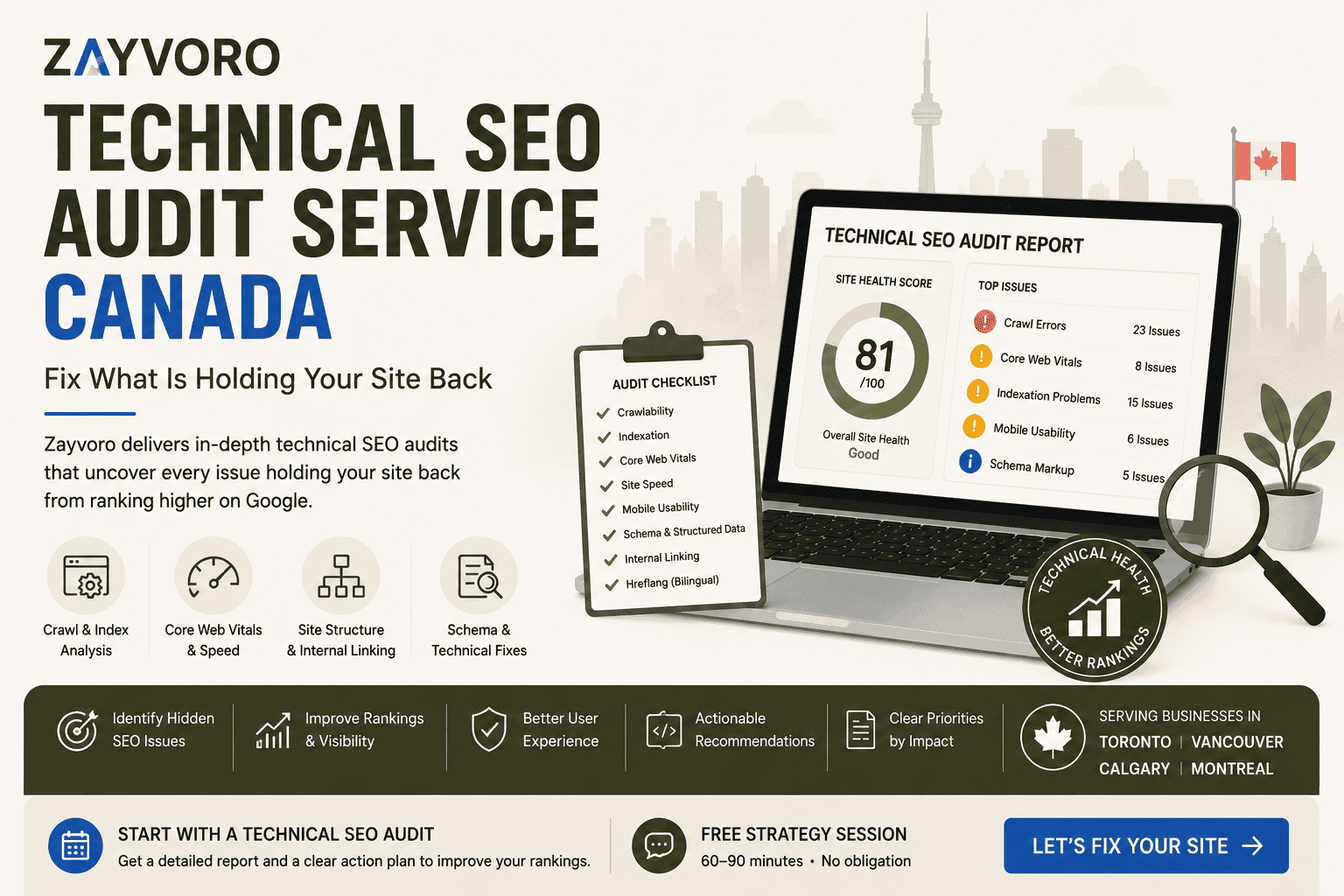
Zayvoro delivers technical SEO audit services for businesses across Toronto, Vancouver, Calgary and Montreal — written audits that name every crawl blocker, indexation problem, Core Web Vitals failure, and schema gap ranked by impact. The technical audit is where every serious SEO engagement starts.
What Is a Technical SEO Audit?
A technical SEO audit is a systematic examination of every factor that affects how search engines crawl, index, and rank your website — independent of content quality or backlink profile. It answers one question: is your site structured in a way that allows Google to find, understand, and rank your pages?
- Technical SEO issues such as broken links, missing Open Graph tags, poor Core Web Vitals, improper internal linking, and site structure problems can severely hinder your website’s visibility in search results. A well-written page with strong backlinks can still fail to rank if the technical foundation underneath it is broken
- A technical SEO audit evaluates crawlability, indexation, site speed, structured data, and mobile usability to ensure your website meets modern search performance standards. Issues such as broken links, duplicate content, poor Core Web Vitals, and misconfigured directives can limit rankings regardless of content quality.
- In practice, a technical SEO audit for a Canadian business looks like this: we crawl the site with Screaming Frog, pull impressions and coverage data from Google Search Console, run Core Web Vitals against real Canadian user data, check hreflang implementation for bilingual sites, and audit schema markup against Google’s Rich Results Test. The output is a prioritised written report — every issue named, every fix explained, and every item ranked by ranking impact.
Why Technical SEO Audits Matter for Canadian Businesses
Canadian businesses invest in content and links and then wonder why rankings stall. In most cases, the answer is technical. A site that cannot be crawled efficiently wastes every dollar spent on content. A site with duplicate content confuses Google about which page to rank. A site failing Core Web Vitals loses ranking ground to technically cleaner competitors — even when the content is stronger.
Toronto’s competitive search landscape makes technical health non-negotiable. The businesses ranking at the top of competitive Toronto searches in 2026 are not just producing more content — they are running cleaner sites that Google can crawl and index without friction.
Vancouver’s tech-heavy market means buyers and search engines both expect fast, mobile-optimised experiences. A Vancouver site failing PageSpeed benchmarks loses ranking ground and conversion rate simultaneously — two problems one technical audit can surface and address.
Calgary and Edmonton businesses frequently run older WordPress installations with plugin conflicts, bloated databases, and unoptimised image libraries that slow crawling and hurt Core Web Vitals without anyone noticing. A single technical audit often uncovers years of accumulated technical debt quietly suppressing rankings.
Montreal businesses face an additional layer: bilingual sites with improper hreflang configuration are among the most common technical issues we find. When hreflang is misconfigured, Google serves the wrong language version to the wrong audience — French pages to English searchers and English pages to Quebec buyers.
What Our Technical SEO Audit Covers
Every Zayvoro technical SEO audit covers the following in full. Each area is examined in depth — not skimmed with an automated tool and exported as a PDF.
Crawl health and indexation. We crawl every URL on your site and identify pages that are blocked, incorrectly noindexed, orphaned, or returning error codes. We cross-reference crawl data with Google Search Console coverage reports to find the gap between what Google has attempted to crawl and what it has indexed.
Core Web Vitals and page speed. We pull field data from CrUX for real Canadian user experience scores and lab data from PageSpeed Insights. Every failing URL is identified, the cause diagnosed, and the fix specified — whether that is image compression, render-blocking JavaScript, server response time, or layout shift.
Site architecture and internal linking. We map the internal link graph to identify pages with too few internal links, pages cannibalising each other for the same keywords, and crawl depth issues that push important pages too far from the homepage.
Duplicate content and canonicalisation. We identify all duplicate and near-duplicate URLs, check canonical tag implementation, audit pagination, and flag parameter-handling issues that create index bloat without adding ranking value.
Schema markup and structured data. We audit existing schema implementation against Google’s Rich Results Test and identify opportunities to add LocalBusiness, Article, FAQPage, Product, and BreadcrumbList markup that improves search appearance and AI citation eligibility.
Hreflang and international SEO. For Canadian businesses with bilingual or international sites, we audit every hreflang tag for accuracy, completeness, and return-tag compliance — the most commonly broken element on bilingual Canadian websites.
What Separates a Zayvoro Technical Audit from a Generic Report
Most technical SEO audits produced by Canadian agencies are one of two things: an automated Semrush or Ahrefs export dressed up as a PDF, or a traffic-light report that tells you things are red, amber, or green without explaining what to do about any of it.
A Zayvoro technical SEO audit is a written document. Every issue is described in plain English. Every fix is specified in enough detail that a developer can implement it without a follow-up call. Every item is ranked by its estimated impact on rankings — so you know whether to fix the robots.txt issue first or the Core Web Vitals problem first.
What separates our technical audit from the typical Canadian agency engagement is the discipline of prioritisation. A crawl of a medium-sized Canadian site typically surfaces two hundred to four hundred issues. Most of them are low impact. Fixing them all first is how agencies fill hours without moving rankings.
We rank every issue by impact and sequence the fixes so the ranking-critical work happens in weeks one through four — not buried in a backlog that never gets actioned.
How We Deliver the Technical SEO Audit
The audit runs through three stages, each one building on the previous.
1. Crawl and data collection. We crawl the site with Screaming Frog, pull Google Search Console data including coverage, performance, and Core Web Vitals reports, run PageSpeed Insights across priority page templates, and collect log file data where available. For bilingual sites, we collect data for both language versions separately.
2. Analysis and prioritisation. We analyse the crawl data against the indexed page set, identify every technical gap, and rank each issue by its estimated impact on crawl efficiency, indexation, and ranking performance. Issues are grouped into three priority tiers: fix immediately, fix within thirty days, and fix within ninety days
3. Written audit delivery. The output is a written audit document covering every issue, including its description, cause, fix specification, and priority ranking. The document includes a one-page executive summary for leadership and a detailed technical appendix for developers. We walk through the audit on a call and remain available for questions during implementation.
Results You Can Expect from a Technical SEO Audit
A technical SEO audit does not directly produce rankings. It removes the barriers that are preventing rankings from improving. The speed of impact depends on what the audit finds and how quickly the fixes are implemented.
Crawl and indexation fixes typically show impact within two to four weeks — Google recrawls corrected pages quickly once the barriers are removed. Core Web Vitals improvements appear in field data within twenty-eight days of deployment. Schema markup additions can produce rich results within one to two weeks of validation.
Most Canadian businesses that act on a Zayvoro technical audit within thirty days of delivery see meaningful improvements in Google Search Console coverage data, crawl statistics, and Core Web Vitals scores within sixty days. Ranking improvements for pages that were technically suppressed typically follow within three to six months.
Industries That Benefit Most from Technical SEO Audits in Canada
A technical SEO audit works for any business with a website, but the impact is greatest in industries where technical issues are both common and highly damaging.
Ecommerce. Large product catalogues generate duplicate content, pagination issues, and parameter bloat that suppress category and product page rankings. Technical audits for Canadian ecommerce sites frequently uncover thousands of unnecessary indexed URLs competing against one another.
Healthcare and professional services. Sites that have grown through content additions without architectural review frequently develop cannibalisation problems — multiple pages competing for the same procedure or service keyword. The audit identifies and resolves these conflicts.
Real estate. Property listing sites generate dynamic URLs, duplicate listing content, and structured data opportunities that most real estate businesses have never implemented. A technical audit typically uncovers significant schema markup gaps that affect search appearance.
SaaS and technology. JavaScript-heavy sites frequently have crawl and rendering issues that prevent Google from fully seeing page content. Technical audits for SaaS businesses often surface rendering problems that have been suppressing rankings for months without anyone knowing.
Have a project in mind?
Strategy sessions are free and run 60–90 minutes.
Common Questions About Technical SEO Audits in Canada
Ready to grow your business with Zayvoro?
Get a free consultation today.