SEO
Generative Engine Optimisation Canada — Get Your Business Cited in ChatGPT, Gemini and Perplexity Before Your Competitors Are
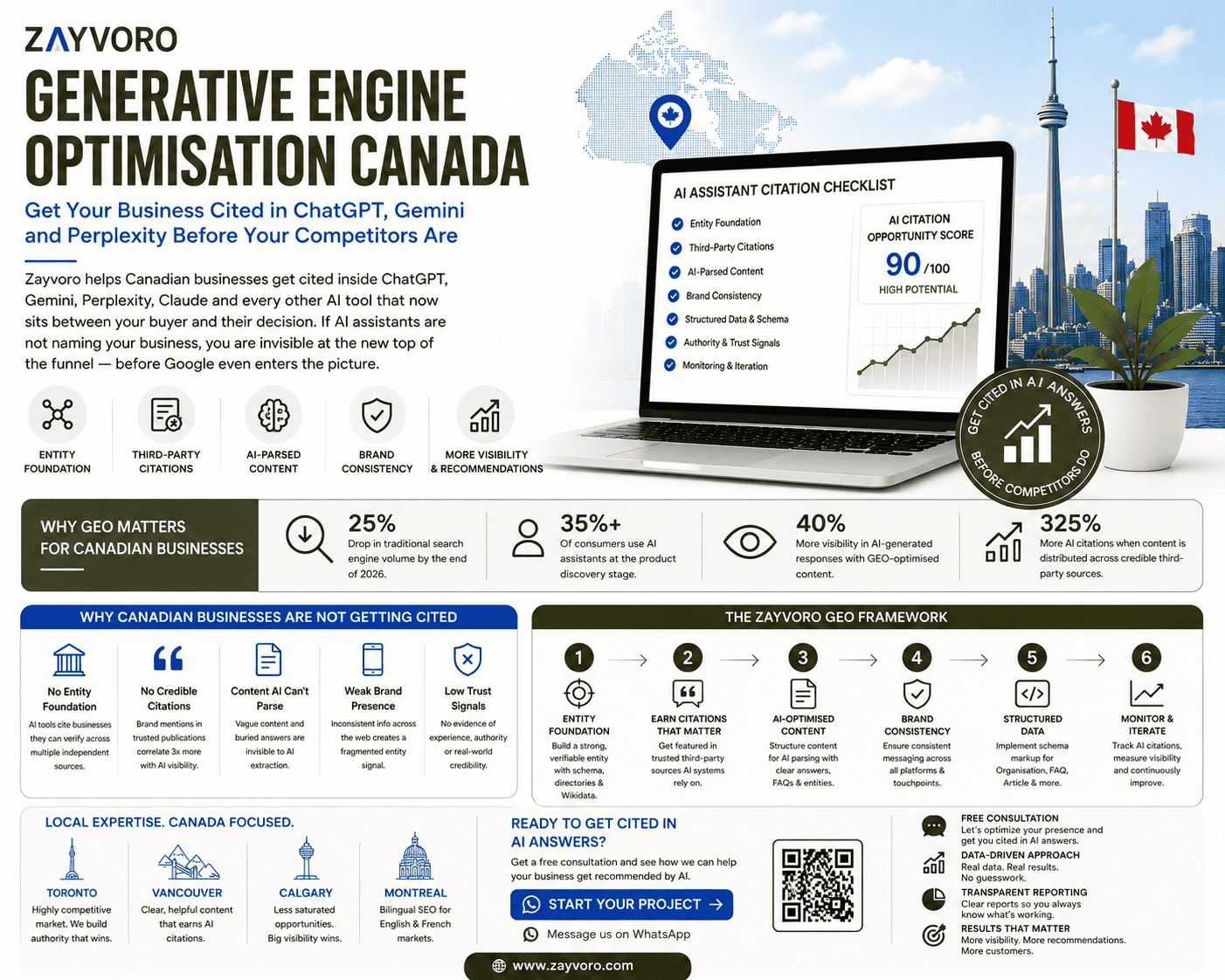
Zayvoro helps Canadian businesses get cited inside ChatGPT, Gemini, Perplexity, Claude and every other AI tool that now sits between your buyer and their decision. If AI assistants are not naming your business when Canadian buyers ask questions in your category, you are invisible at the new top of the funnel — before Google even enters the picture.
What Is Generative Engine Optimisation and Why Does It Matter for Canadian Businesses?
- Generative engine optimisation, or GEO, is the discipline of structuring your web presence so that large language models — ChatGPT, Gemini, Perplexity, Claude, and others — cite, reference, and recommend your business by name when users ask them questions. Unlike Google, which ranks pages in a list, generative AI systems synthesise a direct answer and name specific businesses inside that answer. Being one of those named businesses is the new competitive position in 2026.
- The numbers are no longer speculative. Traditional search engine volume is projected to drop by 25 percent by the end of 2026 as AI tools absorb more queries. Over 35 percent of consumers now use AI assistants at the product discovery stage — compared to just 13.6 percent who use traditional search. Canadian buyers in Toronto, Vancouver, Calgary, and Montreal are asking ChatGPT which agency to hire, which accountant to call, which software to use — and the brands that get cited in those answers win the consideration set before any Google search happens.
- This is not a trend you can wait out. GEO-optimised content gets up to 40 percent more visibility inside AI-generated responses than unoptimised content. Distributing content to a wide range of credible publications increases AI citations by up to 325 percent compared to publishing only on your own site. The Canadian businesses that move first on GEO are building a citation footprint that compounds — the longer competitors wait, the harder it becomes to displace them.
- If your current digital strategy ends at page one of Google, 2026 is going to cost you. Your competitor who has built for GEO is being recommended by name inside ChatGPT responses to your target buyers — right now. Every day without GEO is a day that recommendation belongs to someone else.
Why Canadian Businesses Are Not Getting Cited in ChatGPT, Gemini and Perplexity
Most Canadian businesses are not being cited in AI assistant responses for the same reason they were not appearing in featured snippets five years ago: their web presence is not structured for AI extraction. Generative AI systems do not reward businesses that are well-known in general. They reward businesses with a clear, consistent, parseable entity footprint that AI systems can verify and reference with confidence.
No entity foundation. AI systems cite businesses they can verify. A business without Wikipedia or Wikidata presence, inconsistent information across directories, and no structured Organisation schema is a low-confidence entity. Low-confidence entities do not get cited — regardless of how good the product or service is.
No credible third-party citations. Brand mentions correlate three times more strongly with AI visibility than backlinks. A Canadian business mentioned only on its own website is invisible to AI systems that weigh citations in credible third-party sources — industry publications, regional news outlets, business directories, and partner platforms — as primary trust signals.
Content that AI cannot parse. AI systems favour content with explicit claims, direct answers, clear positioning statements, and structured information. Canadian business websites with long, vague introductions, no clear service definitions, and no FAQ content are structurally invisible to AI extraction — regardless of how much organic traffic they currently receive.
Weak or inconsistent brand presence. AI assistants aggregate brand information from dozens of sources. A business described differently across its website, LinkedIn, Google Business Profile, and directory listings creates a fragmented entity signal. Fragmented entities do not get confidently cited. Consistency of positioning, services, and credentials across every web property is a foundational GEO requirement.
How to Get Your Canadian Business Cited in AI Assistants — The Zayvoro GEO Framework
Getting cited in ChatGPT, Gemini, and Perplexity requires a different strategy than ranking on Google. The signals that determine AI citation are distinct from traditional SEO ranking signals — and most Canadian businesses are investing in the wrong thing. Here is what actually moves the needle.
Build your entity foundation first. AI systems cite businesses they can verify across multiple independent sources. Organisation schema deployed properly on your website, consistent business information across all directories, and a credible Wikidata or Wikipedia presence where appropriate are the non-negotiable starting points. Without an entity foundation, every other GEO tactic produces diminished returns.
Get cited in the sources AI systems trust. Distributing content to credible third-party publications — industry outlets, regional Canadian news, authoritative directories, and partner platforms — is the single highest-impact GEO lever available. AI systems draw heavily from the sources they were trained on and actively retrieve from. A Canadian business cited in those sources gets recommended; one that is not, does not.
Restructure your core pages for AI parsing. About pages, Services pages, and category pages need explicit entity definitions, clear positioning statements, and structured information that AI systems can extract without inference. Vague brand language, generic introductions, and buried service descriptions are the most common content failures on Canadian business websites targeting AI citation.
Build FAQ content across every priority page. FAQ sections are disproportionately cited by AI assistants because they are already structured as questions and answers — the exact format generative engines extract from. Five to eight genuinely useful questions per page, with answers between 40 and 80 words, directly increases AI citation eligibility for the queries those questions match.
Deploy structured data for AI extraction. FAQPage schema, Article schema, LocalBusiness schema, and Organisation schema with detailed attributes tell AI systems exactly what your business does, who it serves, and why it is authoritative — without the AI having to infer it from unstructured content. Schema markup is the fastest technical change that improves AI citation eligibility and the most consistently skipped by Canadian agencies.
Maintain brand consistency across every web property. AI systems aggregate from LinkedIn, Google Business Profile, industry directories, and your own website simultaneously. A business described consistently across all of these — same services, same positioning, same credentials — sends a coherent entity signal. Inconsistency creates doubt. AI systems do not cite businesses they are uncertain about.
Produce content that includes data, statistics, and evidence. Including data and statistics in content increases AI citation probability significantly. AI assistants favour sources that make specific, verifiable claims over sources that make general statements. Canadian businesses that publish original research, case studies, and data-backed content build citation authority that generic content cannot compete with.
How Zayvoro Builds GEO Programmes for Canadian Businesses
The work runs through four phases, each one building on the last. GEO is not a one-time implementation — it is a compounding programme that accumulates citation authority over six to twelve months.
1. GEO audit and citation baseline. We run real query sequences against ChatGPT, Gemini, Perplexity, and Claude for the queries your Canadian buyers actually ask. We document which brands are currently being cited, audit your entity footprint across structured data, directories, and credible third-party mentions, and identify the specific gaps — missing schema, weak entity signals, no third-party citations, unparseable content — that are preventing citation.
2. Entity foundation and content restructuring. We deploy Organisation schema, FAQPage schema, and LocalBusiness schema across priority pages, restructure About and Services pages for AI parsing, and ensure brand information is consistent across every web property your buyers and AI systems encounter. Every change is documented so you can see exactly what was implemented and why.
3. Citation and authority building. We identify the credible Canadian and industry publications, directories, and platforms that AI systems draw from, and build your brand’s presence there through outreach, partnership content, digital PR, and resource page inclusion. This is the phase that produces compounding GEO results — each new credible citation increases the probability of AI assistant recommendation.
4. Monitoring and iteration. We re-run query sequences quarterly against ChatGPT, Gemini, Perplexity, and Claude for your target queries, track which brands are cited and whether your brand has entered the citation set, and adjust content and citation strategy based on what the data shows. GEO visibility evolves as AI systems update — ongoing monitoring is not optional.
Results Canadian Businesses Can Expect from GEO
GEO produces compounding results, not overnight rankings. Most engagements show first AI citation appearances within three to four months as entity foundation work takes effect and credible third-party sources begin publishing content referencing the brand. Consistent AI assistant visibility — your business appearing regularly in responses for category-defining Canadian queries — typically emerges between months six and twelve.
GEO-optimised content gets up to 40 percent more visibility inside AI-generated responses. Businesses with strong third-party citation footprints are cited up to 325 percent more frequently than businesses that only appear on their own websites. These are not theoretical projections — they are the measurable outcomes of structured GEO work applied consistently over time.
The metrics we track: AI assistant citation frequency for target queries via quarterly re-testing across ChatGPT, Gemini, Perplexity, and Claude; entity strength signals across structured data and directories; inbound enquiry volume from prospects who mention AI assistants as their discovery source; and brand mention velocity across credible third-party publications. We report these alongside standard SEO and traffic data every month.
Generative Engine Optimisation by Canadian City
Toronto. The most competitive GEO landscape in Canada. Toronto businesses in finance, legal, professional services, tech, and healthcare compete for AI citation against well-funded competitors with established content libraries and existing publication footprints. GEO in Toronto requires not just entity foundation work but genuine citation depth — multiple credible sources referencing your brand across the publications and platforms AI systems weight most heavily.
Vancouver. Tech, professional services, and lifestyle brands in Vancouver compete for AI citation on research-heavy queries from buyers who ask detailed questions before converting. Vancouver buyers increasingly start their vendor research with ChatGPT or Perplexity — the businesses cited in those responses capture the buyer at the research stage, before competitors see them, before any paid ad is served, and before any Google search happens.
Calgary. Industrial, energy, and professional services businesses in Calgary compete for lower-volume but high-intent queries where AI citation can capture the entire top-of-funnel. The GEO opportunity in Calgary is significant and underexploited — most competitors in Calgary’s core industries have not begun building for AI citation, which means first-mover advantage is still available to businesses that act now.
Montreal. Bilingual GEO is essential for Montreal businesses. French-language queries in Quebec trigger separate AI responses from English-language queries — responses that draw from French-language sources, French-language structured data, and French-language entity signals. A Montreal business that has built GEO only in English is invisible in AI responses for the majority of Quebec searches. Both languages require separate content, separate schema, and separate citation programmes.
Have a project in mind?
Strategy sessions are free and run 60–90 minutes.
Common Questions About Generative Engine Optimisation in Canada
Ready to grow your business with Zayvoro?
Get a free consultation today.