
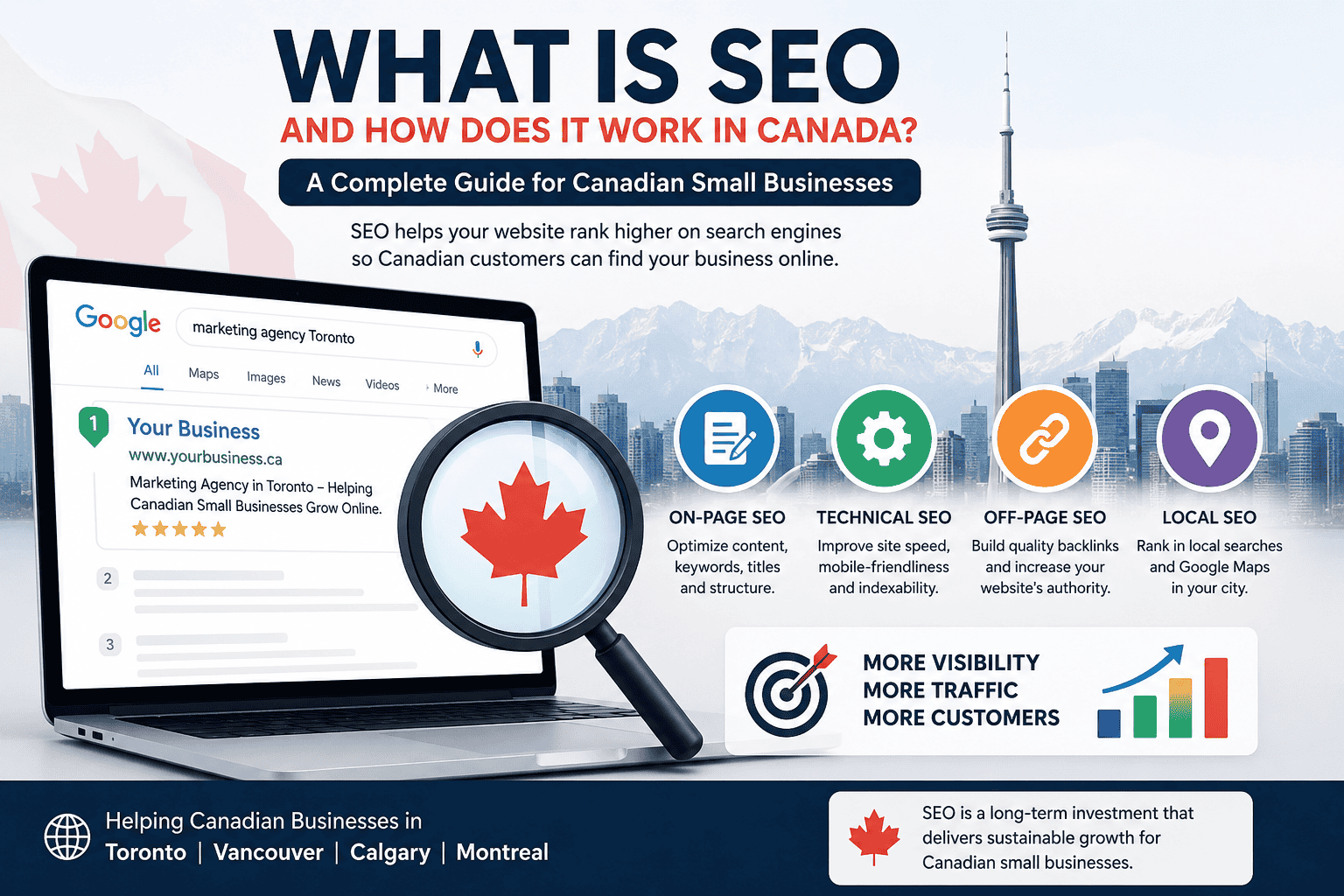
SEO
What Is SEO and How Does It Work in Canada A Complete Guide for Canadian Small Businesses
Zayvoro explains what SEO is, how it works, and why it matters specifically for small businesses across Toronto, Vancouver, Calgary, and Montreal competing for visibility in Canadian search results.
What Is SEO?
- SEO — Search Engine Optimisation — is the process of improving your website so that it appears higher in search engine results when Canadian buyers search for the products and services you offer. When someone in Toronto searches “Instagram marketing agency Canada” or a Vancouver buyer searches “small business marketing service near me,” SEO determines whether your website appears on the first page of results or gets buried on page five where almost no one looks.
- SEO is not a one-time fix. It is an ongoing process of making your website more relevant, more trustworthy, and more useful than the competing websites targeting the same Canadian buyers you are trying to reach.
How Do Search Engines Work?
Search engines like Google work in three stages — crawling, indexing, and ranking.
Crawling. Google sends automated bots across the internet to discover web pages. These bots follow links from page to page, collecting information about every page they visit — the content, the structure, the speed, and the links pointing to it.
Indexing. Once a page is crawled, Google stores it in its index — a massive database of every page Google has discovered and evaluated. If your page is not indexed, it does not appear in search results regardless of how good the content is.
Ranking. When a Canadian buyer types a search query, Google scans its index and ranks the most relevant, trustworthy, and useful pages in order. The page Google considers most relevant to that specific search query appears first. SEO is the work of making Google consider your page the most relevant result for the searches your Canadian customers are actually typing.
What Are the Main Types of SEO?
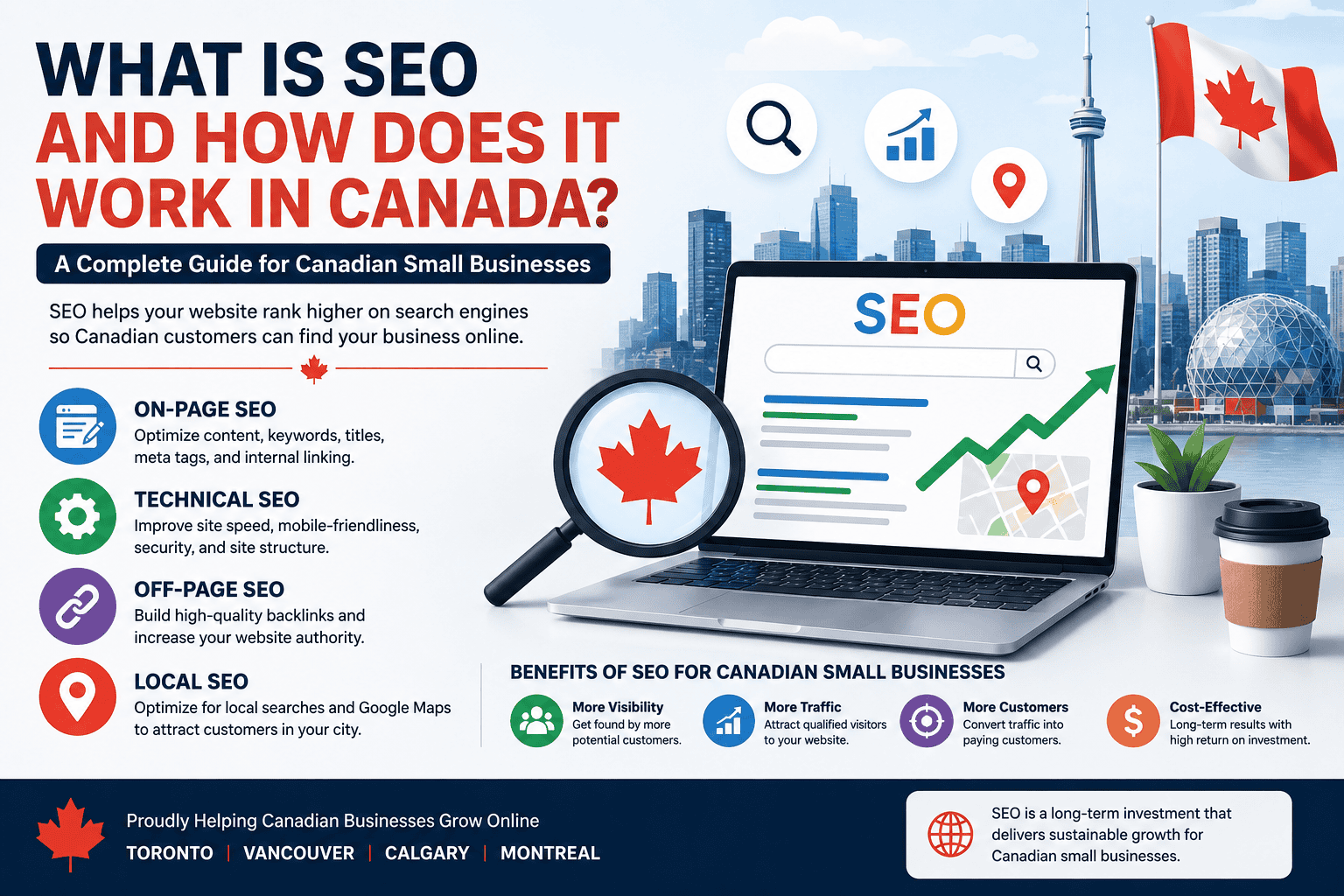
SEO breaks into four main areas — each one important for Canadian small businesses trying to rank in Canadian search results.
On-Page SEO. On-page SEO is everything on your website that you control directly — the words on the page, the headings, the page titles, the meta descriptions, the URL structure, and the internal links between your pages. On-page SEO tells Google what each page on your website is about and which search queries it should appear for.
Technical SEO. Technical SEO is the behind-the-scenes work that makes your website easy for Google to crawl and index — page speed, mobile optimisation, secure HTTPS connection, clean URL structure, and fixing crawl errors that prevent Google from accessing your pages. A technically sound website gives your content the best possible chance of ranking. A technically broken website holds back even excellent content.
Off-Page SEO. Off-page SEO is everything that happens outside your website that influences your rankings — primarily backlinks. A backlink is a link from another website pointing to yours. Google treats backlinks as votes of confidence. Canadian small businesses with more high-quality backlinks from relevant Canadian websites rank higher than competitors with fewer backlinks, all else being equal.
Local SEO. Local SEO is the specialised practice of optimising your website and online presence to appear in location-based searches — searches like “marketing agency Toronto” or “small business SEO Vancouver.” For Canadian small businesses serving customers in specific cities or provinces, local SEO is often the highest-value SEO investment available. Local SEO includes Google Business Profile optimisation, local citation building, and location-specific page content.
How Does SEO Work in Canada Specifically?
SEO in Canada works the same way as SEO anywhere — but competing in Canadian search results requires understanding several factors specific to the Canadian market.
Google.ca vs Google.com. Canadian buyers typically search on Google.ca, and Google serves different results based on the searcher’s location. A Canadian small business targeting Toronto buyers needs to rank on Google.ca for Toronto-specific searches — not just generic English-language searches. Google uses the searcher’s IP address and location settings to determine which results are most geographically relevant.
2. Entity foundation and content restructuring. We deploy Organisation schema, FAQPage schema, and LocalBusiness schema across priority pages, restructure About and Services pages for AI parsing, and ensure brand information is consistent across every web property your buyers and AI systems encounter. Every change is documented so you can see exactly what was implemented and why.
Bilingual search behaviour. Canada has two official languages. French-speaking Canadians in Quebec and other francophone communities search in French. A Canadian small business targeting both English and French Canadian buyers needs separate English and French content strategies to capture both audiences in search results. English SEO and French SEO are separate disciplines — translated English content rarely ranks as well as natively written French content for French Canadian search queries.
Canadian spelling and terminology. Canadian English uses British spelling in some cases — “colour” instead of “color,” “centre” instead of “center,” “organise” instead of “organize.” Canadian buyers searching for local businesses use Canadian spelling, and content written with Canadian spelling signals to Google that your website is genuinely relevant to Canadian searchers rather than American content repurposed for the Canadian market.
Provincial and city-level targeting. Canada is a geographically large country with distinct provincial markets. A Canadian small business targeting Alberta buyers competes in a different search landscape than one targeting British Columbia or Ontario. Effective Canadian SEO targets specific provinces and cities — not just “Canada” as a single market.
What Does Google Look for When Ranking Canadian Websites?
Google evaluates hundreds of factors when ranking websites in Canadian search results. The most important ones for Canadian small businesses are:
Relevance. Does your page clearly answer the search query a Canadian buyer typed? Pages that directly and thoroughly address the search query rank higher than pages that only partially cover the topic.
Authority. Does Google trust your website? Authority is built primarily through backlinks from other credible Canadian websites — news sites, industry publications, local business directories, and partner websites that link to your content.
User Experience. Does your website load quickly on mobile? Is it easy to navigate? Do visitors stay on your pages or leave immediately? Google tracks user behaviour signals and rewards websites that Canadian buyers find genuinely useful and easy to use.
Content Quality. Is your content accurate, detailed, and genuinely helpful to the Canadian buyer reading it? Google’s algorithms have become increasingly sophisticated at evaluating content quality — thin, generic, or duplicated content rarely ranks well in competitive Canadian markets
Local Signals. For local Canadian searches, does your website include consistent business name, address, and phone number information? Is your Google Business Profile complete and actively managed? Do local Canadian websites link to yours? Local signals determine whether your business appears in the local map pack — the three businesses Google highlights at the top of local search results.
How Long Does SEO Take to Work in Canada?
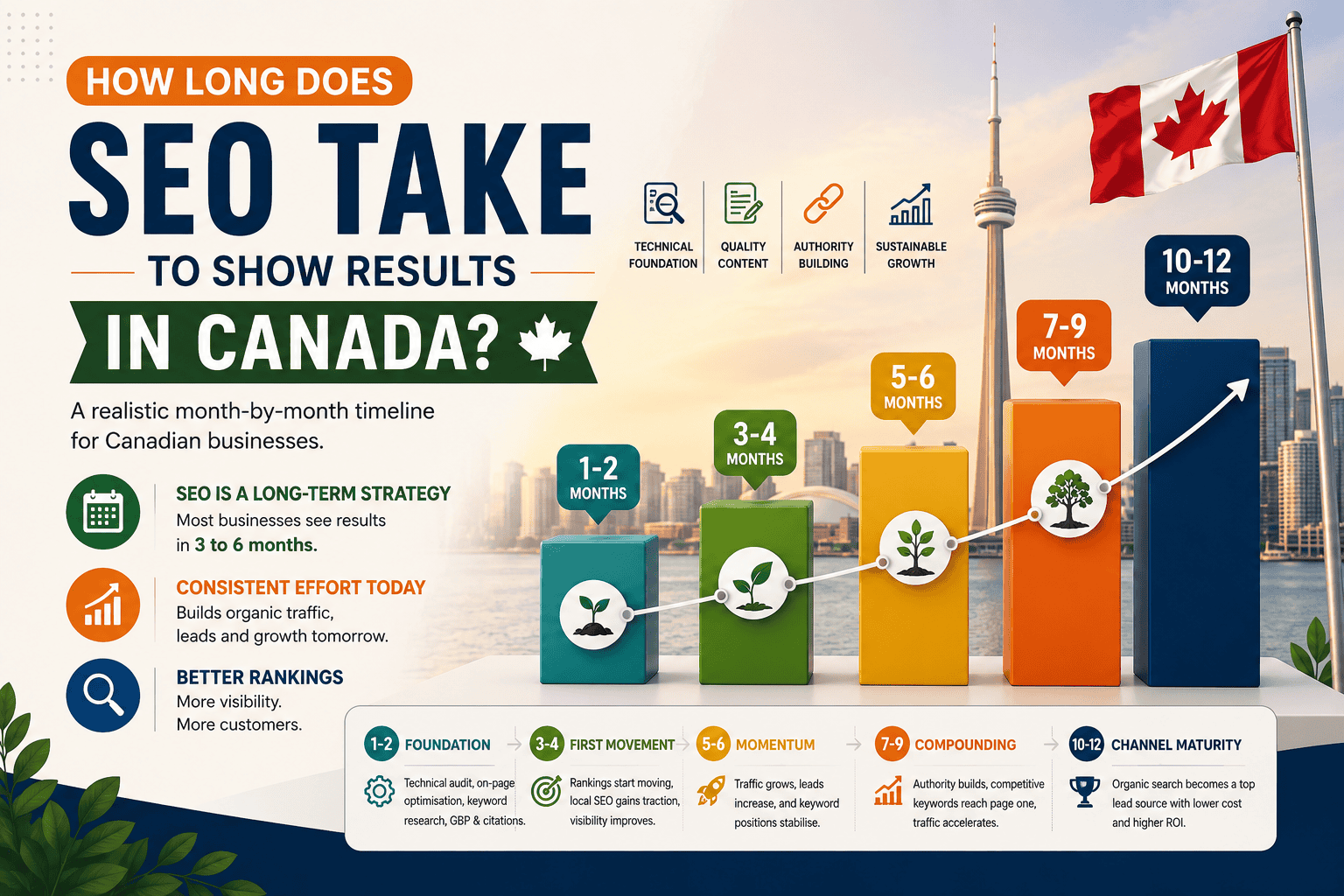
SEO is a long-term investment, not a quick fix. Canadian small businesses starting SEO from scratch typically see measurable improvement in search rankings within three to six months of consistent work. Competitive keywords in large Canadian markets like Toronto and Vancouver can take six to twelve months or longer to rank on the first page — because established competitors have years of authority and backlinks that take time to match.
The timeline depends on three factors: how competitive the keywords are, how strong your website’s existing authority is, and how consistently the SEO work is executed. Canadian small businesses in less competitive local markets — smaller cities, niche industries — often see ranking improvements faster than businesses competing for high-volume keywords in Toronto or Vancouver.
What Is the Difference Between SEO and Paid Search in Canada?
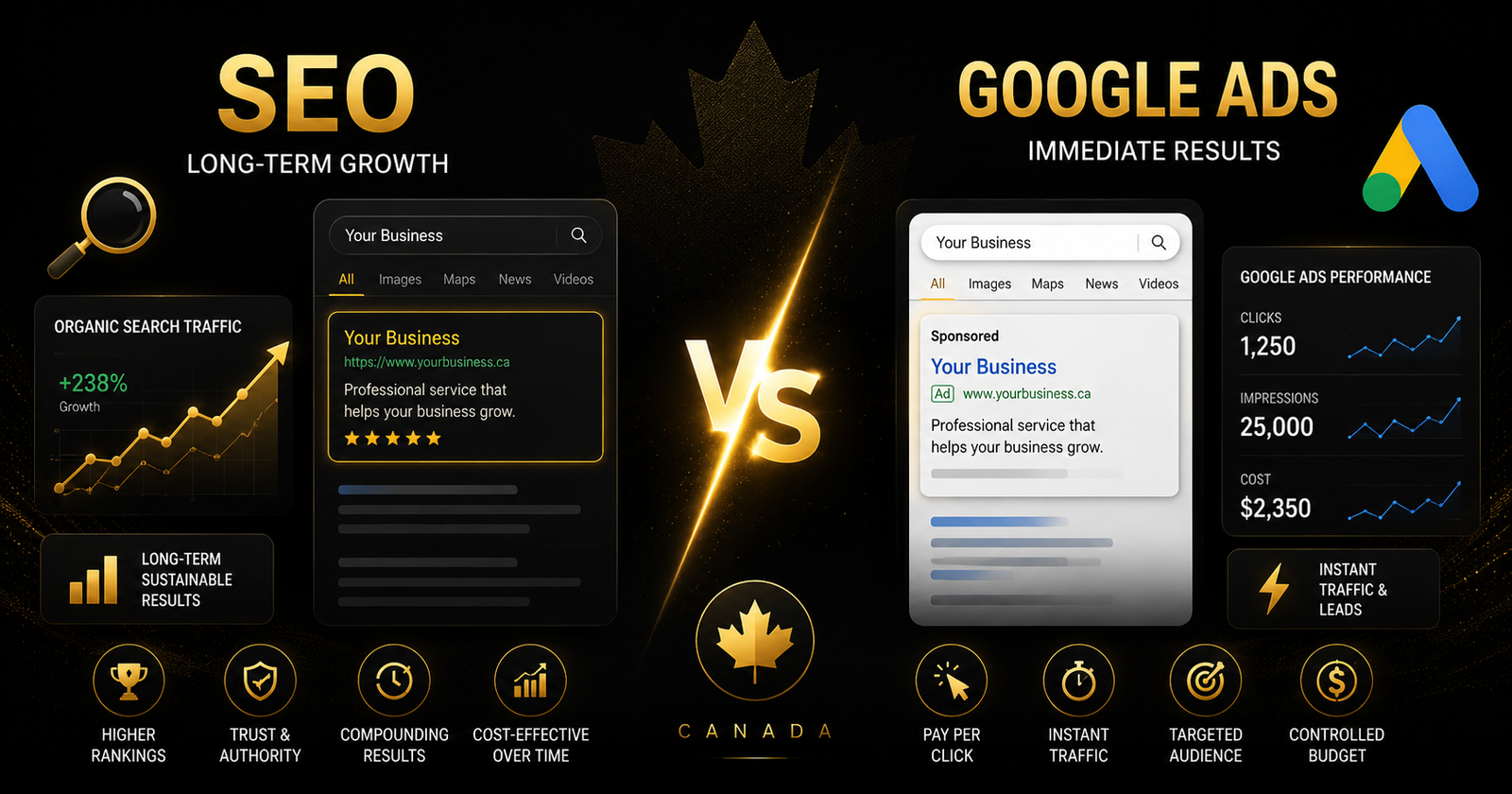
SEO produces organic search rankings — positions in Google’s search results that you earn through content quality and authority rather than paying for directly. Paid search — Google Ads — produces paid search results that appear above organic results and are charged per click.
The key difference for Canadian small businesses is this: SEO builds an asset. Rankings you earn through SEO continue to generate traffic without ongoing cost per click. Google Ads traffic stops the moment you stop paying. Most Canadian small businesses benefit from running both — Google Ads for immediate traffic and lead generation while SEO builds the long-term organic presence that reduces dependence on paid traffic over time.
SEO for Canadian Small Businesses by City
Toronto. Toronto is Canada’s most competitive SEO market. Small businesses in Toronto compete against established national brands, large agencies, and thousands of local competitors for the same search queries. Toronto SEO requires a long-term commitment to content quality, technical excellence, and local authority building — specifically targeting Toronto neighbourhoods and districts where your customers are located.
Vancouver. Vancouver’s SEO landscape is competitive across industries but particularly in wellness, technology, real estate, and food and beverage. Vancouver SEO focuses on hyper-local content targeting specific Metro Vancouver communities — North Vancouver, Burnaby, Richmond, Surrey — and building backlinks from BC-based business associations, local media, and industry publications.
Calgary. Calgary’s SEO market is less saturated than Toronto or Vancouver in most industries, meaning Canadian small businesses with consistent SEO investment typically see faster ranking improvements. Calgary SEO prioritises local citation building, Google Business Profile optimisation, and content targeting Alberta-specific search behaviour — particularly in trades, energy services, and professional services.
Montreal. Montreal SEO requires bilingual strategy. French and English search queries in Montreal produce different search results, and competing effectively in both requires separate French and English content, separate keyword research, and separate authority building strategies. Zayvoro builds fully bilingual SEO strategies for Montreal businesses targeting both language communitier
Have a project in mind?
Strategy sessions are free and run 60–90 minutes.
Common Questions About SEO in Canada
Ready to grow your business with Zayvoro?
Get a free consultation today.
Leave a Reply